What Is Keyword Difficulty? How To Read Your KD Score
Summarize this post with AI
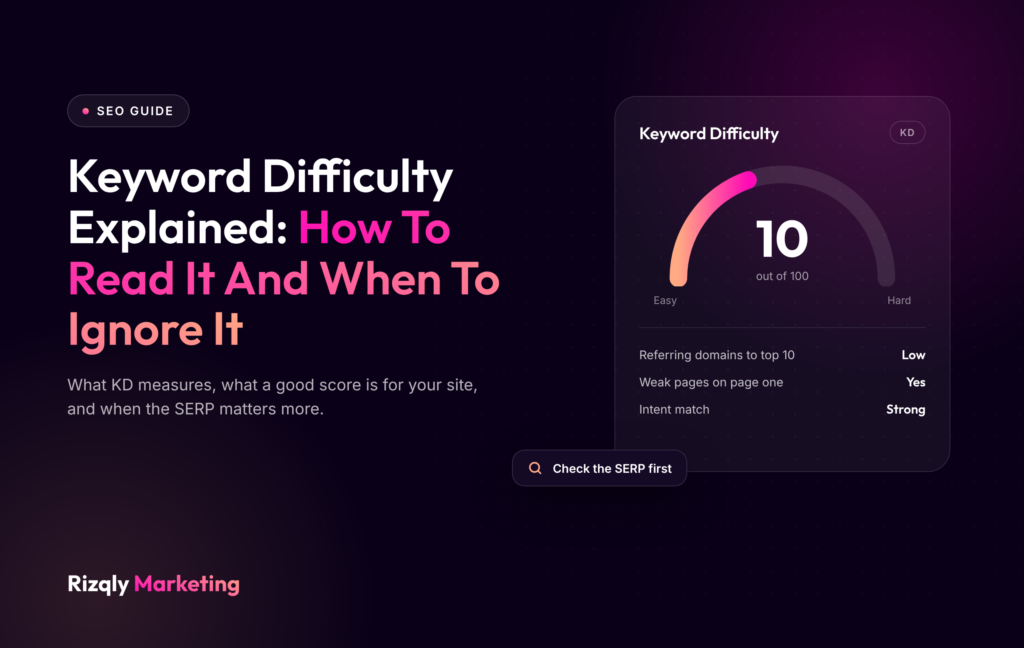
What is keyword difficulty? It is a 0 to 100 score that SEO tools give a keyword to estimate how hard it will be to rank in Google's top 10 for it. Higher means harder. Each tool calculates it differently: Ahrefs bases it on how many websites link to the pages already ranking, while Semrush blends links with other signals. So treat KD as a quick filter, not a verdict. A score of 40 can be easy for an established site and out of reach for a new one, and a high score can hide weak pages you could beat. The rest of this guide shows how to read the number for your own site and when to ignore it.
What Is Keyword Difficulty?
KD Meaning In Plain Terms
KD stands for keyword difficulty. It is a third party estimate, not a Google metric: Google never publishes how hard a keyword is. The tools look at the pages already ranking and score how strong they are. That makes KD useful for sorting a list of 500 keyword ideas quickly, and much less useful for deciding on any single keyword.
How Ahrefs Calculates It
Ahrefs keeps it simple. It pulls the top 10 ranking pages for a keyword and counts how many websites link to each one; the more linking websites, the higher the score (Ahrefs). Ahrefs also shows a hint under the score, an estimate of how many referring domains you would need to reach the top 10. Because “ahrefs kd” is based only on links, it says nothing about content quality or intent.
How Semrush Calculates It
Semrush describes KD% as the SEO effort it would take to rank in the top 10 for a keyword (Semrush). Its formula mixes several signals from the ranking pages, including referring domains and the authority of the ranking sites. Semrush also offers Personal Keyword Difficulty, which adjusts the score for your own domain.
Why The Same Keyword Gets Different Scores
Different inputs give different numbers, so a keyword can score 20 in one tool and 45 in another. Neither is wrong. Pick one tool, learn what its numbers mean for your site, and never compare a keyword difficulty score from one tool with a score from another.
How To Read A Keyword Difficulty Score For Your Site
Most guides on what is keyword difficulty stop at the definition. Reading the score for your own site is the part that actually changes which keywords you choose.
What Is A Good Keyword Difficulty?
There is no single good number. A new site with few backlinks should start with keywords well under 20. A site with a few years of links and content can compete in the 20s and 30s. Only established sites with strong authority in the topic should plan around 50 and above. The right range depends on your site, which is why the next step matters more than any rule of thumb.
Compare KD With Keywords You Already Rank For
Open Google Search Console, export the queries where you already rank in the top 10, and look up their KD in your tool. If most sit under 15, that is your current comfort zone, and anything above 30 is a stretch. Repeat this every few months; as your site earns links, the ceiling rises.
Check The SERP Before You Trust The Number
A score is an average of ten pages. Averages hide things. Before you decide, search the keyword yourself and look at who actually ranks.
Five Things To Look At In The Top 10
- Weak pages: thin articles, old posts or forum threads ranking in the top five.
- Intent: whether Google shows guides, product pages, tools or local results.
- Big brands: a page one full of household names is harder than the score suggests.
- SERP features: AI Overviews, featured snippets and video results that push organic links down.
- Freshness: whether every result is from the last few months, which means you will need to keep updating.
A Real Example: The Keywords Behind This Article
Here is the Ahrefs data (US) for the keywords we considered for this page, pulled on November 17, 2026:
Keyword | Monthly volume | KD | What it tells you |
keyword difficulty | 6,100 | 59 | The head term; hard for most sites |
keyword difficulty checker | 4,300 | 52 | Tool intent: people want a calculator, not a guide |
seo difficulty | 2,000 | 55 | Hard, and mostly a synonym |
what is keyword difficulty | 1,300 | 10 | Same topic, question format, far easier |
keyword difficulty score | 900 | 30 | Medium |
low competition keywords | 700 | 2 | Very easy |
The lesson: “what is keyword difficulty” covers exactly the same topic as the KD 59 head term but scores 10. A page that answers the question well can rank for the easy version first and pick up the harder variants as it earns links. That is how a newer site gets a foothold on a competitive topic.
When To Ignore Keyword Difficulty
The honest answer to what is keyword difficulty measuring is mostly links. Here are five cases where links are not the deciding factor.
The SERP Has Weak Pages Despite A High Score
If a forum thread or a three year old article ranks in the top five, the score is being lifted by a few strong pages further down. A clearly better page can often break in, even when the KD looks high.
The Intent Matches Something Only You Offer
If you sell the exact thing people are searching for, your product or service page can rank on relevance even when the KD is high. The score only counts links; it doesn’t know you are the best answer.
Local And Map Pack Searches
For “near me” and city searches, the map pack sits above the organic results and is ranked on relevance, distance and prominence, not the backlinks KD measures. A local business can win the map pack for a keyword whose KD looks impossible.
You Are Building Topical Authority
Sometimes you publish a hard keyword because the topic needs it: a pillar page that ties a cluster together. It may not rank for its head term for a year, but it helps the easier pages around it. Our GEO vs SEO comparison explains why topic coverage matters even more now that AI tools pick sources by topic.
AI Answers Are Taking The Clicks Anyway
A low KD keyword is not worth much if Google answers it in an AI Overview and few people click. Check whether an AI Overview appears, and read our guide on getting your pages cited in Google AI Overviews. Our roundup of AI search statistics shows how much search behavior has already shifted. And remember that buyers now ask ChatGPT and Perplexity too, where no KD score exists at all: visibility there is measured with AI visibility tracking tools and brand mention tracking, not keyword rankings.
How To Find Low Competition Keywords
Low competition keywords are where most new sites should start. In Ahrefs or Semrush, filter your keyword list to KD under 20, then add these filters: question keywords (what, how, why), longer phrases of four words or more, and terms with a clear intent you can serve. Then run the five point SERP check on the shortlist. A good low competition keyword has real volume, an intent you can satisfy, and at least one weak page in the top 10.
If every keyword in your market is high KD and you need traffic now, paid search can bridge the gap while SEO builds. Rizqly runs Google Ads campaigns that cover the hard keywords while organic pages climb.
Common Keyword Difficulty Mistakes
- Skipping every keyword above 30, even when the SERP shows weak pages.
- Comparing KD from different tools.
- Choosing keywords by KD and volume alone, without checking intent.
- Ignoring the parent topic: an easy question keyword can carry a whole topic.
- Forgetting that KD measures the top 10, not position one.
The fix for all of these is the same: once you understand what is keyword difficulty telling you, use KD to sort, then let the SERP decide. If you would rather have a team handle research, content and links together, Rizqly’s SEO services cover the full process, and our AI search optimization guide covers the AI side.
For more on how search is changing beyond rankings, read what generative engine optimization is, how to rank on ChatGPT and how schema markup for AI search helps machines understand your pages.
Frequently Asked Questions
Q1: What Is Keyword Difficulty In SEO?
What is keyword difficulty in SEO? It is a 0 to 100 score from tools like Ahrefs and Semrush that estimates how hard it is to rank in Google’s top 10 for a keyword. Higher is harder, and each tool calculates it differently.
Q2: What Does KD Mean?
KD means keyword difficulty. It is a third party estimate based mainly on the backlinks and authority of the pages already ranking, not a number Google publishes.
Q3: What Is A Good Keyword Difficulty For A New Website?
Usually under 20. Check which KD range your site already ranks for in Google Search Console and aim slightly above it as your site grows.
Q4: Why Do Ahrefs And Semrush Show Different KD Scores?
They use different formulas. Ahrefs counts linking websites to the top 10 pages, while Semrush blends several signals. Compare scores within one tool only.