Track Brand Mentions In AI: A 4 Step Guide For 2026
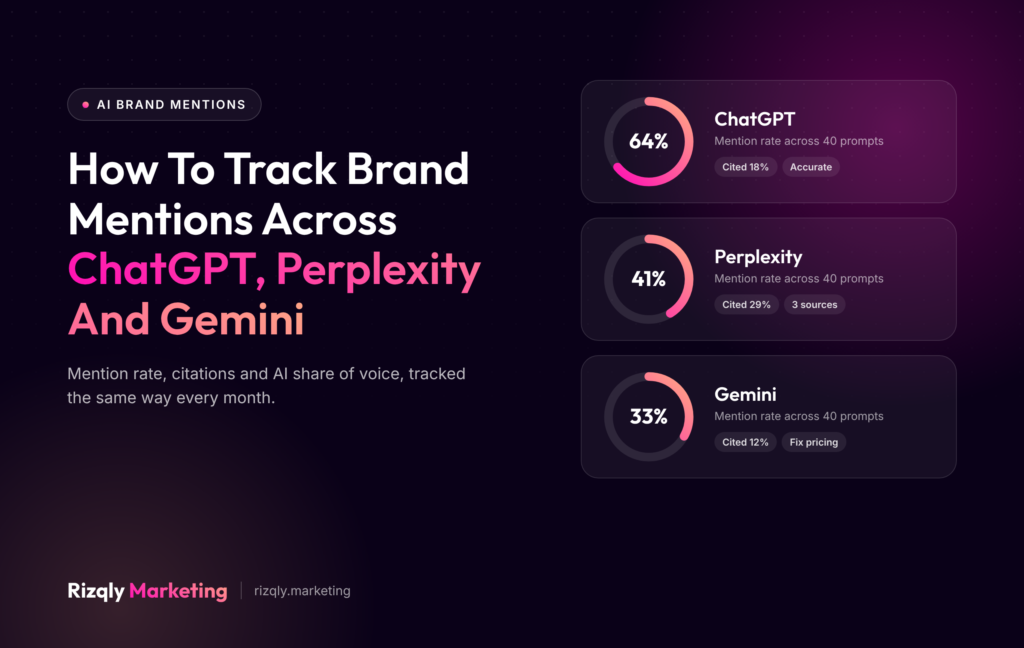
To track brand mentions in AI, build a fixed set of prompts your buyers actually ask, run each one several times on ChatGPT, Perplexity and Gemini, and record how often your brand is mentioned, cited and described accurately compared with competitors. Then add the data the platforms give you for free: Google Search Console’s generative AI report, Bing’s AI Performance report and AI referral traffic in GA4.
Do it the same way every month and you get a trend you can trust. Below is the four step process, a GEO reporting template you can copy, and what to do when AI doesn’t mention you at all.
What To Measure Before You Start
Before you track brand mentions in AI, decide what you’ll measure. “Are we in ChatGPT?” is a yes or no question. The useful version is “how often, how accurately, and against whom?” These four metrics answer it.
Mention Rate
The share of answers that name your brand. If 100 runs across your prompts mention you 28 times, your mention rate is 28%. This is the core number for AI brand mentions, and the one to report first.
Citation Rate
The share of answers that link to your website as a source. You can be mentioned without being cited, and cited without being recommended, so track both.
AI Share Of Voice
Your mentions as a share of all brand mentions in your category across the same prompts. If competitors are named 80 times and you 20, your AI share of voice is 20%. It shows where you stand, not just whether you appear.
Accuracy And Sentiment
Is the AI describing you correctly (services, prices, locations) and positively? A wrong price or an outdated service in an AI answer can cost you more than not being mentioned.
Step 1: Build A Prompt Set That Reflects Real Buyers
Every attempt to track brand mentions in AI starts with the prompts. Get them wrong and every number after that is wrong too.
Four Types Of Prompts To Include
• Category prompts: “best digital marketing agency for dentists in Texas”
• Problem prompts: “why are my Google Ads getting clicks but no leads”
• Comparison prompts: “[your brand] vs [competitor]”
• Brand prompts: “is [your brand] any good”, “[your brand] pricing”
Pull wording from sales calls, support emails, Search Console queries and the “grounding queries” in Bing’s report (covered below). Real phrasing beats keyword lists.
How Many Prompts And Runs You Need
For a small business, 25 to 50 prompts usually cover the main services and buying questions. Larger brands need hundreds. Keep the set fixed for at least a quarter, or your trend lines mean nothing.
Why One Run Is Never Enough
AI answers change almost every time. In a SparkToro and Gumshoe study of nearly 3,000 runs, the odds of getting the same list of brands twice were under 1 in 100, though strong brands still appeared in 60% to 90% of answers. So run each prompt several times, report the percentage, and never report a single screenshot or an “AI rank” position.
Step 2: Check Each Platform The Right Way
The way you track brand mentions in AI differs by platform, so check each one separately. ChatGPT sends roughly three quarters of all AI referral traffic, followed by Gemini and Perplexity, according to SE Ranking’s study of 101,574 websites, which gives you a sensible order of priority.
Tracking Mentions In ChatGPT
Run your prompts in a logged out or fresh session so past chats don’t shape the answer, and note whether ChatGPT searched the web (answers with sources) or answered from memory. Mentions from memory change slowly; mentions from search change as your pages and coverage change. Our guide on how to rank on ChatGPT covers what moves each.
Tracking Mentions In Perplexity
Perplexity always shows its sources, which makes it the easiest place to see why you are or aren’t mentioned. Record the cited domains for each prompt: if the same review site or Reddit thread appears every time, that’s where your brand needs to be. Strong, accurate coverage on social platforms helps here, which is part of the social media marketing work Rizqly does.
Tracking Mentions In Gemini And Google AI Features
Check the Gemini app and Google’s AI Overviews and AI Mode separately; they don’t always agree. Google features lean on pages that already rank, so your normal SEO still matters, as we explain in how to get cited in Google AI Overviews.
Use Search Console’s Generative AI Report
Google rolled out its generative AI report to all websites on August 31, 2026. It shows impressions from AI Overviews and AI Mode by page, country and date. It won’t show the answer text, but it tells you which pages Google’s AI features actually surface.
Don’t Skip Copilot
Copilot is easy to ignore, but it’s built into Windows and Edge, and Bing gives you citation counts, something Google’s report doesn’t show.
Use Bing’s AI Performance Report
Bing Webmaster Tools’ AI Performance report counts citations in Copilot and Bing’s AI summaries, lists the pages cited, and shows sample grounding queries the AI used to find your content. Those queries are free prompt ideas for Step 1.
Step 3: Track AI Referrals In GA4
Prompt tracking shows mentions; GA4 shows what those mentions are worth. It’s the step most teams skip when they track brand mentions in AI.
Create An AI Traffic Channel
By default, GA4 lumps AI visits into “Referral.” A custom channel group separates them. The steps, as laid out in this GA4 AI traffic guide: go to Admin, Data display, Channel groups; copy the default group; add a channel called “AI Traffic” with the condition Source matches regex; then drag it above Referral so GA4 checks it first. A simple pattern to start with:
(chatgpt\.com|chat\.openai\.com|perplexity\.ai|gemini\.google\.com|copilot\.microsoft\.com|claude\.ai)
What Referral Data Can And Can’t Tell You
Referrals show which AI tools send visitors and which pages they land on, and you can tie them to leads. They don’t show mentions that never led to a click, which is most of them. That’s why referral data complements prompt tracking rather than replacing it. For context on how small AI traffic still is overall, see our roundup of AI search statistics.
Step 4: Log Everything In A GEO Reporting Template
Whatever you use to track brand mentions in AI, keep the results in one place. A simple monthly sheet is enough to start, with one row per platform:
| Platform | Prompts x runs | Mention rate | Citation rate | Share of voice | Accuracy issues | Top cited sources |
| ChatGPT | 40 x 5 | __% | __% | __% | e.g. old pricing | __ |
| Perplexity | 40 x 5 | __% | __% | __% | __ | |
| Gemini | 40 x 5 | __% | __% | __% | __ | |
| Google AI features | Search Console | AI impressions: __ | n/a | n/a | Top pages: __ | |
| Copilot | Bing report | Citations: __ | n/a | n/a | Grounding queries: __ | |
| All AI referrals | GA4 | Sessions: __ | Leads: __ | n/a | Top landing pages: __ |
Add one line underneath for what you changed that month (new page, PR coverage, a fix to wrong facts), so you can connect changes to movement.
Manual Tracking Or An AI Brand Mentions Tool?
Manual tracking works for 20 to 30 prompts on three platforms, about two to three hours a month. Beyond that, an AI brand mentions tool saves time and adds repeated sampling, competitor comparisons and history. Options range from add ons in SEO suites, such as Ahrefs Brand Radar, to dedicated platforms; we compare 11 of them, with prices, in our guide to AI visibility tracking tools.
If you’d rather have someone set this up and read it for you, tell us about your brand and we’ll show you where you stand today.
What To Do When AI Doesn’t Mention You
Low AI brand mentions usually point to one of three gaps:
1. Access: AI crawlers can’t read your key pages, often because content loads by JavaScript. Fix the basics first; special files like llms.txt won’t solve it.
2. Answers: your pages don’t clearly answer the prompts. Rewrite service pages and FAQs in plain language with specifics. Schema helps engines understand pages but won’t create mentions on its own, as covered in schema markup for AI search.
3. Authority: the sources AI cites don’t mention you. Earn coverage on the review sites, directories, publications and communities that show up in your Perplexity citations.
All three are part of generative engine optimization, and they build on solid SEO. If you need it run end to end, that’s the AI search optimization work Rizqly does.
Common Mistakes When You Track Brand Mentions In AI
• Reporting a single screenshot. Answers change run to run; report percentages.
• Changing the prompt set every month. You lose the baseline.
• Only tracking branded prompts. Of course AI mentions you when asked about you by name. Category and problem prompts are where buyers decide.
• Ignoring accuracy. A mention with the wrong price or service is a problem, not a win.
• Skipping the free data. Search Console, Bing and GA4 show what actually happened, not estimates.
Frequently Asked Questions
Q1: Can I Track Brand Mentions In AI For Free?
Yes. Run prompts manually, use Google Search Console’s generative AI report and Bing’s AI Performance report, and set up an AI channel in GA4. Paid tools add scale and competitor data.
Q2: How Often Should I Check AI Brand Mentions?
Monthly for most businesses, with a fixed prompt set. Weekly checks on a few priority prompts help during launches or reputation issues.
Q3: Why Does ChatGPT Give Different Answers Each Time?
AI models generate answers with some randomness, and search based answers depend on what they retrieve at that moment. That’s why you measure mention rate across many runs.
Q4: What Is A Good AI Share Of Voice?
It depends on your category and how many competitors are named. Compare yourself with your top three competitors on the same prompts and track the trend rather than chasing a fixed number.